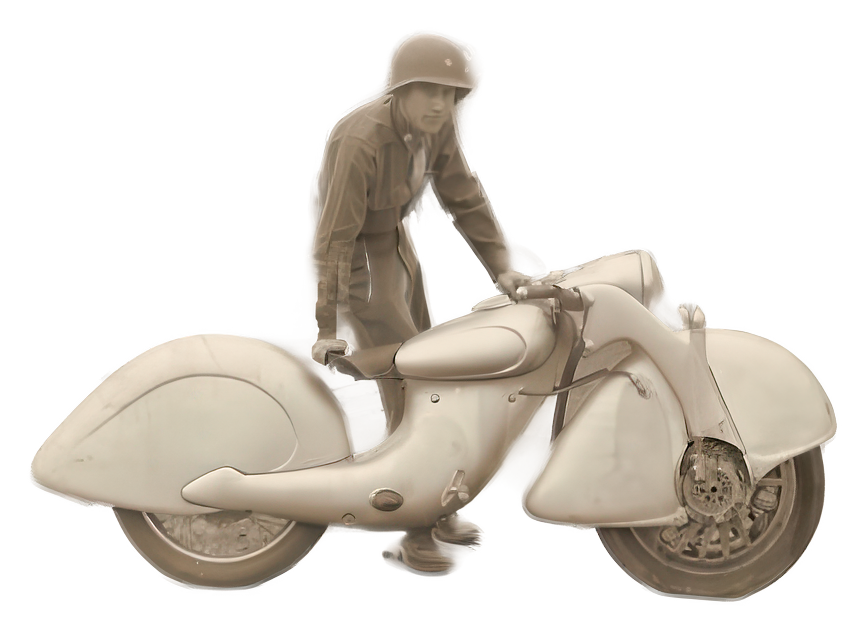
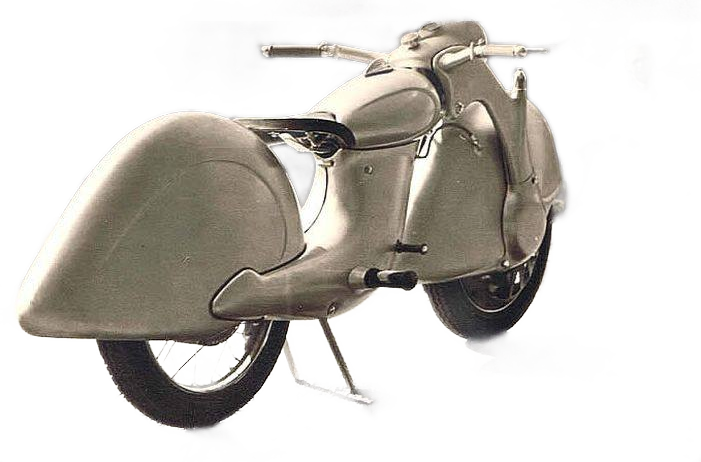
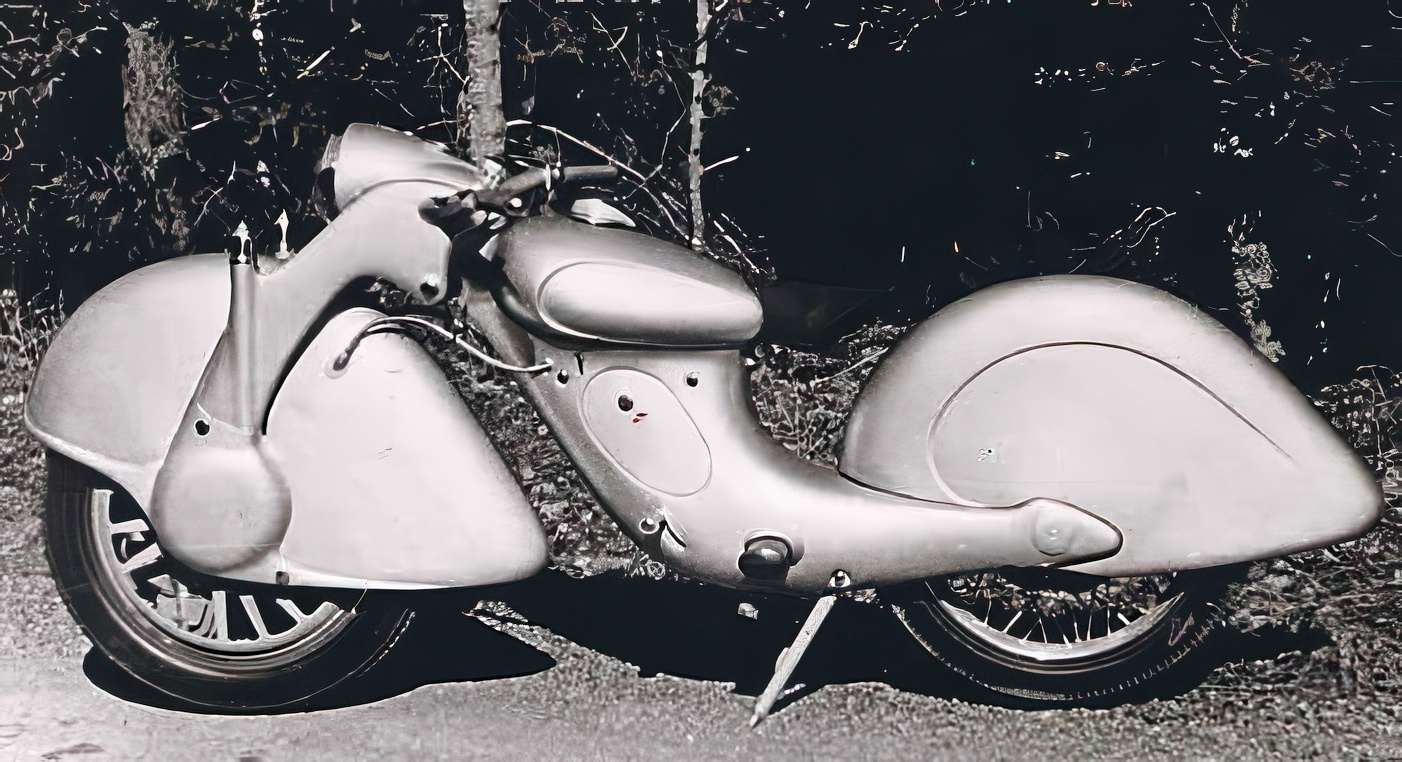
The Killinger and Freund Motorcycle was an attempt in 1935 by a group of five German engineers from Munich to design a more streamlined and modified version of the German Megola front-wheel drive motorcycle. The
work took three years to complete but the result was impressive. The
engine displacement stayed the same as the Megola at 600 cc but was
much lighter and more simplified than a standard 100 cc motorcycle of the time.
The
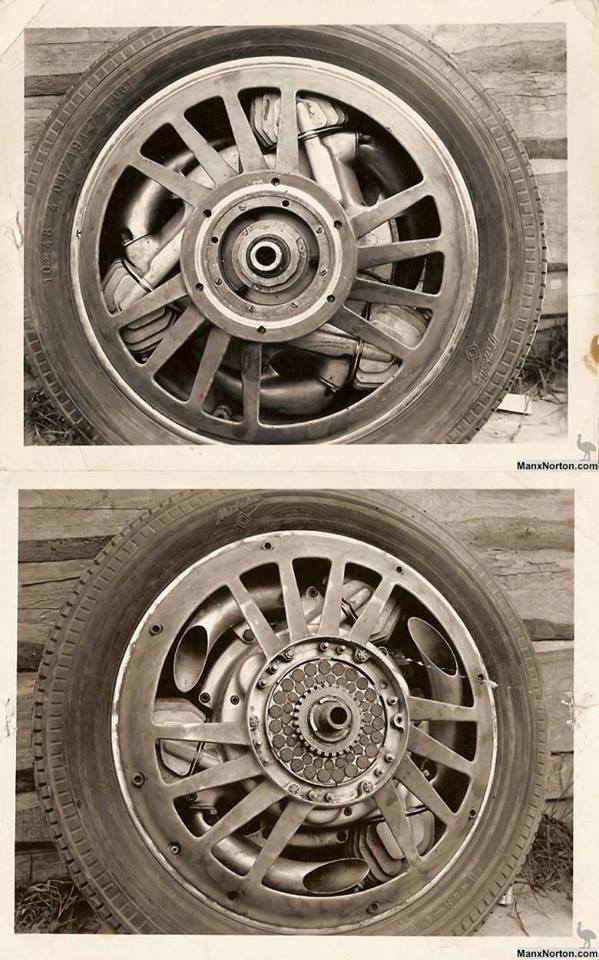
motorcycle featured a three-cylinder two-stroke engine built right into
the front wheel, transmission and clutch, with more comfortable front
and rear suspension. Streamlining was important as aerodynamics was the
first priority of the team who wanted all the moving parts covered,
dirt and mud protection, and an elegant style. Other priorities were
that the motorcycle be multi-cylinder and possess front- wheel-drive.
Their design met with success.
The
first impressions of the new motorcycle was of a streamlined racing
machine with rounded covers for the front and rear wheels,
aerodynamically improved fork, frame, and fuel tank all built on a
tubular framework covered in sheet metal.
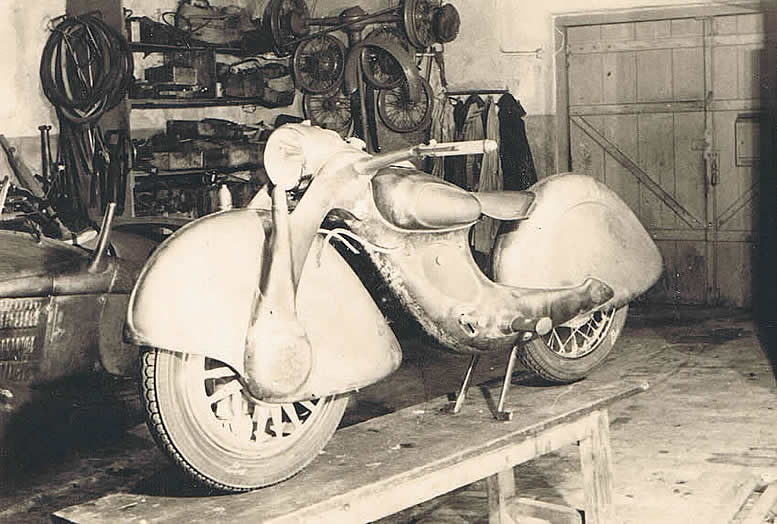
The rear suspension was linked to the lower end of the tubular frame and featured flexible rubber and metal elements
that did not require servicing. Steering was much like an ordinary
motorcycle but with more vertical telescopic elements than usual, which
translated into a wheelbase that wouldn't change much whenever the
front fork dived.
The
new front-wheel-drive was a vast improvement over the old Megola
design. The weight of the engine was lower. The front wheel with
integrated engine had
a combined weight of 50 kg (110 lb). Additionally, a custom
carburetor without a float needle didn't have the problems caused by
vibration. And finally, the light-weight battery ignition allowed trouble-free engine starts and helped to keep the engine weight low. The distributor and the points were located in the hub. The technicians originally intended to build a dynastarter. These improvements would have been impossible to add to the old Megola design.
The three cylinder two-stroke engine used a Drehschieber ("rotary
valve", a turning disk, with intake holes for exact timing of the
fuel-air mixture intake). The fuel-air mixture was sucked in by the
vacuum in the three crankshaft housings as usual. The Drehschieber does the intake timing for all three cylinders. The engine was not a radial engine associated with aircraft and there was no need for a flywheel. All three cranks worked on one common gear. This arrangement and the recoil of the pistons in the turning direction secured a perfect balance of the moving parts. The cylinders were made of KS (Kolbenschmidt) iron cylinder walls
and were embedded in the Silumin alloy engine housing. The only things
that could be visibly identified as engine parts were the alloy
cylinder heads with multiple cooling fins and the exhaust pipes located
between the spokes of the cast alloy front wheel. These flat spokes were designed to serve as a functional cooling fan. The two-speed transmission was built as a differential transmission and used slope-meshed gears. The clutch was
made of conventional clutch disks. The clutch (with the springs at the
outer circle) was located in front of the transmission. The
transmission was actuated by foot-operated steel cables. All parts of
the engine allowed easy access for service work. After the removal of
the engine – only two bolts and some wiring had to be removed – all
important parts were within reach.
The
tire could also be removed easily. You had to unlock a safety mechanism
and then remove the tire completely with the split rim (very similar to
the split rim developed by BMW). The front brake was installed in the hub. The rear suspension also had telescopic oil-filled shock absorbers. The gasoline flowed
down through flexible hoses. A panel in the frame allowed easy access
to the seat springs to adjust the hardness of the seat's suspension.
The
Killinger and Freund Motorrad (motorcycle) was test-driven after the
engine was tested on a test stand. Its total weight was 135 kg
(297 lb)
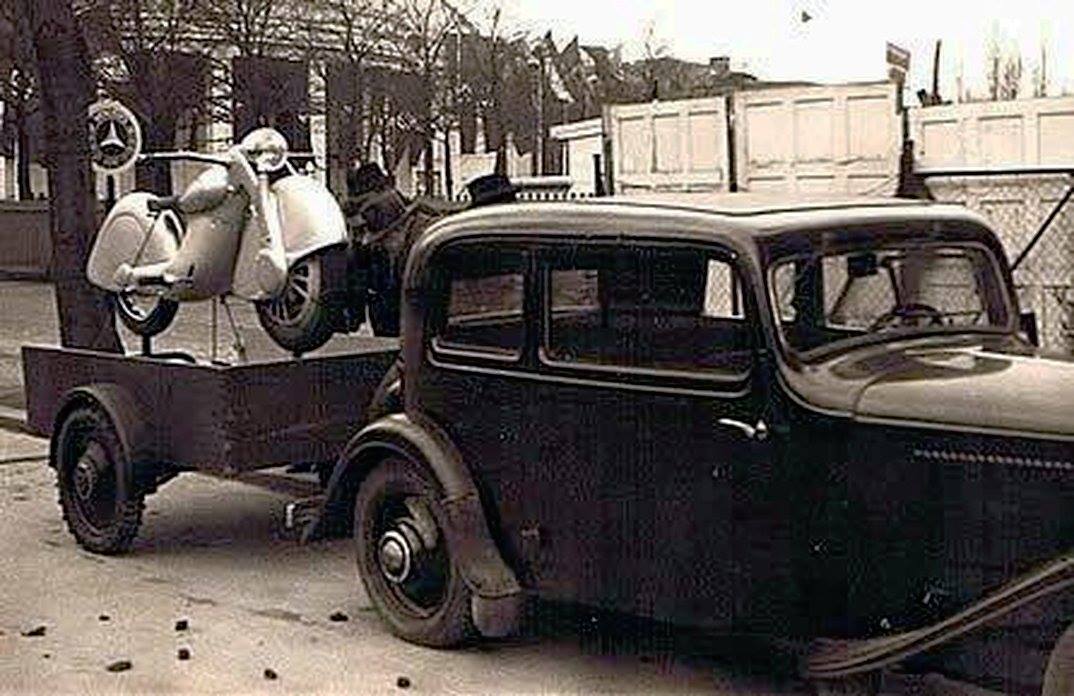
This design was intended for civilian production but the start of World War II cancelled those plans. One motorcycle was discovered by the US Army in the spring of 1945 at a German military installation.
From the Geman MOTORRAD magazine, october 1938. (Translation: Hartmut Schouwer)
In
Italy five plane engineers once built the RONDINE. Now it’s called
GILERA and is destined to win a lot of races for the GILERA brand. When
technicians do something with love, something good will turn out.
Three
years ago five technicians from Munich started to design another
nonconformistic motorcycle, but they had another target: they created a
modern bike with front-wheel-drive and and aerodynamic, rational shape.
That means a bike for daily use. And now it’s ready for the show.
Our
readers will remember the MEGOLA story. The magazine staff had restored
an old MEGOLA to recollect the merits of this multiple-cylinder
front-wheel-drive bike. We wrote: “Fantastic behaviour in curves . . .
a child could ride it on sand . . .”
What
the five technicians from Munich – the names of the designers/engineers
are KILLINGER and FREUND – now completed is more than an improved
MEGOLA. The engine displacement is again 600cc and it is also
incredibly light: 135 Kilogr. (with fuel), but this bike has a
three-cylinder two-stroke engine in the front wheel, it HAS a
transmission and a clutch, it has a comfortable front and rear
suspension and looks elegant and thrilling.
There’s
always a crowd of people around the displayed bike indicating that
there’s happening something great. If you join them and listen to them
you will be astonished that most of them like the shape of this bike.
That’s important because the technicians wanted to build a bike that
can be sold in large numbers some day. The people are used to
aorodynamic shapes of car bodies now and it seems that they already
expected something like that. The
shape was developed to meet all these requirements: all moving parts
covered, dirt protection, multicylinder and front-wheel-drive. Another
target was to reduce the numbers of different parts. This bike has less
parts than a light 100cc-bike!
At
first sight you realize the dirt-protective and aerodynamic covers of
the front and rear wheel. Frame, fork and fuel tank are also
aerodynamically improved. We were impressed by the nice details and
good shaped transitions of the different body parts, as seen on race
bikes.
And
now the construction: the middle of the frame and the rear wheel cover
are currently built as sheetmetal shells around a tube frame. For the
mass-production version there are plans to build the middle frame as a
boxed frame, welded together, using two pressed sheetmetal parts. Of
course this supermachine has a rear suspension. It is linked to the
lower end of the (inner) tube frame and fixed with flexible
(rubber/metal???) elements which don’t need any service. A lid in the
box frame allows access to the seat springs to regulate the hardness of
the seat’s suspension.
The
steering is like that of a normal bike, but the telescopic elements (80
mm lift) are more vertical than usual. That means that the wheelbase
won’t change much when the front fork dives in.
The
front-wheel-drive is much better than the Megola design. First, the
weight of the engine (unsprung weight) is lower. The front wheel with
engine has a weight of 50 Kilos. Second, a custom carb without a float
needle doesn’t have problems that could be caused by vibrations. And
third, the light-weight battery ignition allows to start the engine
without problems and helps to keep the engine weight low. The
distributor and the points are located in the hub. The technicians
originally intended to build a dynastarter. These improvements (plus
transmission and clutch) had been impossible to add to the MEGOLA
design.
The
three-cylinder two-stroke engine uses a Drehschieber (= turning disk
with intake holes for more exact timing of the intake of the fuel-air
mixture). The fresh fuel-air mixture is sucked in by the vacuum in the
three crankshaft housings as usual. The "Drehschieber" does the intake
timing for all three cylinders. The engine is not a radial engine as
known from planes. And there is no need for a flywheel. All three
cranks seem to work on one common gear. This arrangement and the recoil
of the pistons in the turning direction should secure a perfect balance
of the moving parts. The cylinders are made of KS (brand name) iron
cylinder walls and are totally embedded in the Silumin (kind of alloy)
engine housing. Alloy cylinderheads with lots of cooling fins and the
exhaust pipes are the only things that can be identified as engine
parts between the spokes of the cast alloy wheel. These flat spokes are
designed to serve as a cooling fan. The two-speed transmission is built
as a differential transmission and uses slope-meshed gears. The clutch
is made of usual clutch disks. The clutch (with the springs at the
outer circle) is located in front of the transmission. The transmission
is actuated by steel cables (foot-operated). All parts of the engine
allow easy access for service work. After the removal of the engine –
only two bolts and some wiring have to be removed – all important parts
are within reach. The tire can also be removed easily. You have to
unlock a safety mechanism and can remove the tire completely with the
split rim. The front brake is installed in the hub. The rear suspension
also has telescopic oil-filled shock absorbers. The gasoline runs down
through flexible hoses.
Five
men worked for three years on this machine. The bike was test-driven
already and the engine was tested on a test-stand. As there are so many
progressive ideas built into this bike, we hope that the developers
will have a chance to complete their work, because we would like to
experience the preferences of this bike some day:
Better
handling – more safety – less weight – simple construction – no chain
or cardan shaft – no valves – tangential arrangement of the cylinders
for smooth engine characteristics.