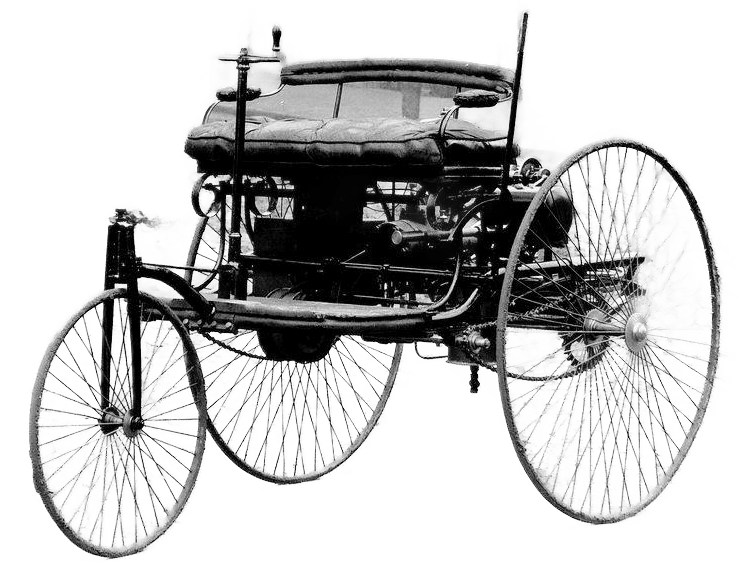
The Benz
Patent-Motorwagen, often referred to as the Benz tricycle, is widely
regarded as the first practical modern automobile. It was designed and
built by the German engineer Karl Benz, and its development marked a
significant milestone in automotive history. Karl Benz developed the
Benz Patent-Motorwagen in 1885, and it was patented in January 1886.
The vehicle was a motorized tricycle with a rear-mounted engine. It
featured many innovative components for its time, including steel
tubing construction with woodwork
panels, steel-spoked wheels,
and solid rubber tires.
The steering mechanism was a toothed rack that pivoted the
unsprung front wheel, and the rear suspension used fully elliptic
springs along with a beam axle and chain drive on both sides. The first
Benz Patent- Motorwagen was powered by a 954 cc single-cylinder
four-stroke engine with trembler coil ignition. This engine produced
approximately 500 watts (2/3 horsepower) at 250 rpm, although later
tests showed it could achieve 670 watts (0.9 horsepower) at 400 rpm.
The vehicle used a simple belt system as a single-speed transmission,
which varied torque between an open disc and drive disc.
The Benz Patent-Motorwagen was not only a technical marvel but also a
commercial success. It was the first car put into production, with
around twenty-five units constructed between
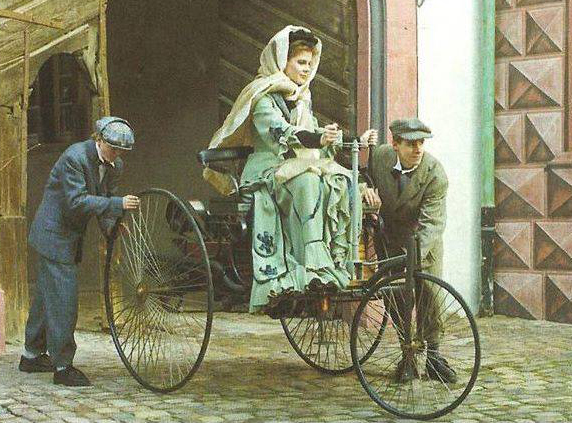
1886 and 1893. Karl Benz's wife, Bertha
Benz, played a crucial
role in demonstrating the vehicle's
practicality. In August 1888, she undertook
the first long-distance journey by
automobile, traveling from Mannheim to Pforzheim and
back, covering a distance of 194 kilometers2. journey This
showcased the reliability and potential of the
motorized vehicle, garnering significant public attention.
The Benz
Patent-
Motorwagen laid the foundation for the modern
motorcycle and car industry. The
vehicle's success contributed to the
establishment of Benz & Cie., which later merged with
Daimler-Motoren-Gesellschaft to form Mercedes-Benz.
|